5. Tadpoles
There they are: translucent blobs and tails like commas wriggling and squirming in the tank. Little mouth parts mowing away at the algae. Andie’s face is pressed up against the tank, big green eyes growing wide like forest pools as she watches. It’s the first time her parents have brought her to see my lab. They’re exhausted from the long flight but Andie just couldn’t wait.
Andie’s face twists in disgust. ‘Eew!’ she says.
No granddaughter of mine is going to be repulsed by tadpoles.
‘They’re not eew,’ I say, ‘Frogs are beautiful. A gardener’s best friend: they eat up all the slugs that destroy my vegetables.’
‘Why are there so many of them?’ she asks.
I settle myself down in a chair next to the sequencing machine and beckon Andie over. ‘It’s a hard life being a tadpole. Most of them would usually get eaten up. In the wild maybe one or two will ever get to be a frog. These ones are special: they’re endangered. You know what endangered means?’
Andie shakes her head.
‘It means that there’s not many left in the wild. Humans pollute or destroy their habitats or they die from parasites. That’s why we look after them here and try to make sure as many survive as possible.’
I frown as I notice the slight murkiness: I’ve told them before we need better filters.
18. Froglets
The summer weather is close and the froglets are starting to leave the pond. As Andie clutches that envelope apprehensively, I can still see that little girl, staring at the water with me.
‘Are you going to open that?’ I ask.
Her hands are shaking as she tears it open slowly and pulls out the letter. The tears start to well as she reads the words on the Cambridge letterheaded paper. I can tell without even looking at it what the outcome must be.
9. Hindlegs
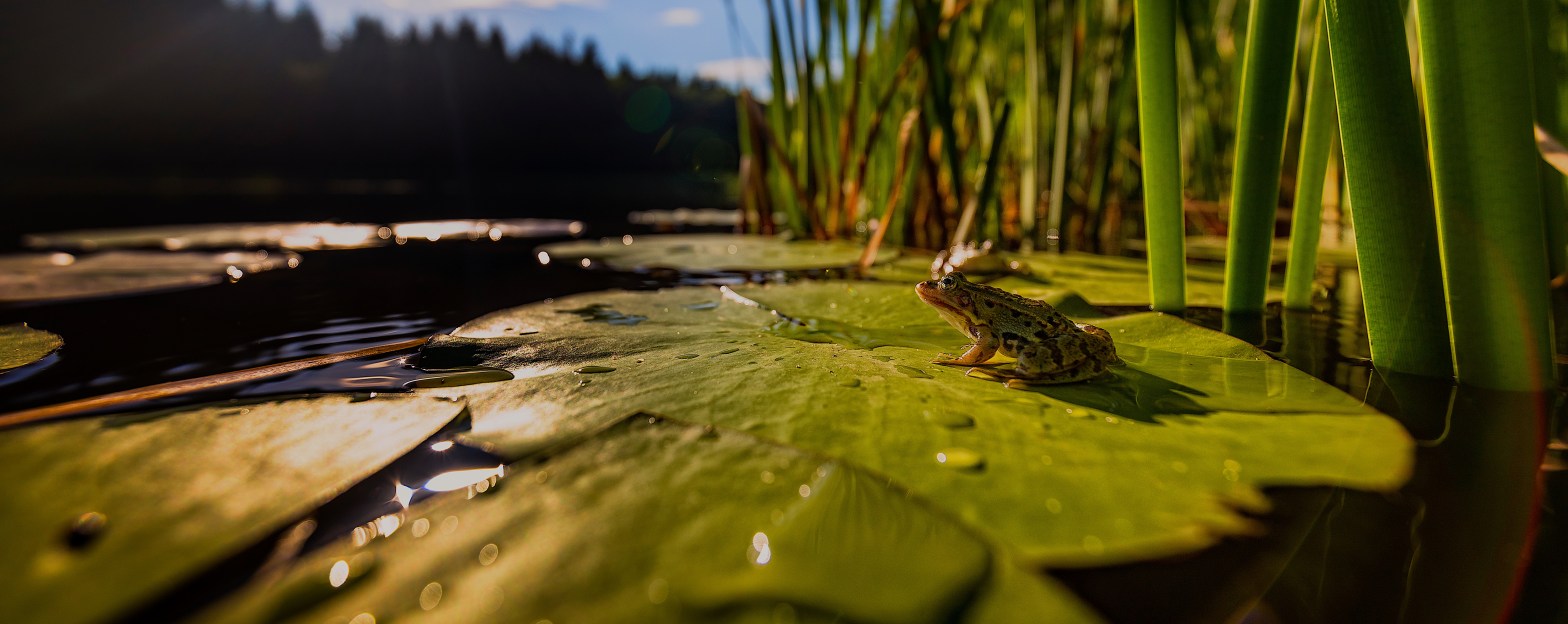
It’s late spring and the tadpoles have the first signs of back legs emerging. Andie and I are sitting by the pond in the garden of my little country cottage. It’s nice to be back closer to my family, somewhere that’s not a long-haul flight away. A dragonfly larva has a tadpole in its clutches, which is writhing and squirming to break free but I can already tell its hopeless.
‘Aren’t you going to help it?’ Andie asks.
‘Nothing to be done,’ I reply.
The dragonfly nymph sucks out the tadpole’s insides and Andie’s eyes start to well up. One more tadpole that will never be a frog.
‘That’s nature, I’m afraid. Like I told you before, most of those will never become frogs, but the dragonfly needs to live too.’ I say.
54. Adulthood
It’s autumn now and the frogs will have already left the pond. The images from the ceremony on the screen dance in front of my eyes. My eyes are going, so I have to squint. The nurses have brought be extra pillows to prop me up, so I can see Andie on the screen and behind her a picture of my old friend.
‘Thank you all,’ screen Andie says. ‘I want first of all to thank my grandmother for instilling in me the passion for research. This specimen was bred in my grandmother’s lab where its genome was sequenced. Without that basis, I would never have been able to make the connection between these genetics and their application to human diseases.’
18. Froglets
It’s been two weeks and the froglets are starting to lose their tails. The ones that made it will be leaving soon. Andie turns another letter over in her hands.
‘I know it’s not Cambridge,’ I say, ‘But it’s an excellent University.’
Come late November, I’m on a train with Andie’s favourite chocolate cake for her birthday.
I arrive at her dorm, and as I gently knock, Andie opens the door. I can tell straight away that something is wrong. I sit down next to her on the bed, which is the only place in this small room.
‘Jen and I had a fight,’ she says, looking at her feet.
‘Your girlfriend Jen, right?’
Andie’s eyes go wide.
‘Just because I’m old doesn’t mean I’m not perceptive. No-one cries like that over just a good friend.’
She clutches her hands, refusing to meet my eyes.
‘She dumped me,’ she says.
‘You know what they say,’ I say. ‘You have to kiss a lot of frogs before you find your princess.’
She wipes her eyes and lets out a small laugh.
‘I thought you liked frogs, and you always said they were beautiful?’ she says.
‘You’re right,’ I concede, ‘Well, how about this? There’ll be a lot of tadpoles in your life but only some of them will get to be frogs. Don’t worry, someday you’ll find the frog that will be your princess.’
29. Losing tails
Andie looks stunning.
‘Here,’ I say, pinning the frog brooch to her dress. ‘Something old.’
‘Your favourite brooch. Thank you,’ she says.
‘It’s your brooch, now. Better not be late,’ I say. ‘Don’t want to leave Sophie waiting.’
5. Frog
My heart sinks as I take it in. The fungus has contaminated almost all the tanks. I told them the filters were not good enough. And yet, I know in my heart that this is my responsibility. How could I have messed up so badly?
We sterilise and treat everything, but I already know in my heart that for most of them it is too late. Only a handful of tadpoles make it. As the weeks pass, we lose more, until by the end of the season only one remains. Out of a clutch of 500, only one has actually gotten to be a frog. Maybe that will be enough.
A grandmother’s love for her granddaughter, Andie, is expressed through a connection to science, nature, and frogs. This piece jumps in time, as denoted by the numbered subtitles, each corresponding to Andie’s age. Starting at 5 and ending at 5, this author brilliantly centres nature’s awe at the core of the storytelling—its terrors and hopes.
Avi Ben-Zeev
Charming and dazzling in its simplicity, “The Life Cycle of Frogs” captures the complexities of two lives, a grandmother and her granddaughter, in surprising and compelling ways. Extended metaphor has never read so good!
Deesha Philyaw
Victoria is an Oxfordshire-based researcher with an interest in speculative fiction and science. They are particularly intrigued by the interplay between science and philosophy.
 Oxford Flash Fiction Prize